

Introducing GREEN FEAST
A look inside our upcoming monograph
We are pleased to announce the upcoming release of our monograph, GREEN FEAST, in the coming weeks, as well as a public release event and live reading. Subscribe to our newsletter to receive updates; in the meantime, enjoy the full introduction to this third installment in the Feast book series.
I N T R O D U C T I O N
With this book, part of a series of four, we intend to offer a distinct approach to seasonal ritual practice. In presenting these disparate traditions, we offer not instructional ritual, but a broad palette of techniques with which one may paint an idiosyncratic practice aligned with the seasons. A large corpus of recorded traditions from many times and places may be available for use and adaptation, but we need the skill to identify that information’s occult context in order to put it to good use. Intent & context enable engagement with traditions that were not formally inherited, in ways that have local, embodied significance and effect.
We invite you to look at these contents to explore their internal logic, underlying magical principles, and ritual arrangements, so you may craft your own practices with the flesh you have on the land you live, with the bones you have inherited.
Seasons are not abstract intellectual notions—they are distinct series of changes undergone by the beings of a local ecology, in response to the rhythmic dance of Planet and Star. The equal four-season model, though convenient, is unlikely to match up with one’s experience of time & place. In the Northern hemisphere, the year is often experienced as a depth of DARK-COLD and a peak of LIGHT-WARM, joined by two ephemeral passages.
Though winter maintains a relative plethora of traditional festivities, we see in the ‘United States’ a curious lack of such customs in spring. The most ubiquitous holiday is Easter, and it is not taken particularly seriously; only about a third of those who celebrate do so in a religious context. The rest of the time, it is a casual dinner event like Thanksgiving, though more oriented toward children. Without a religious basis, the holiday is a confused mess of symbols that are rarely explored for their meanings—and still, Americans find a way to spend over 20 billion dollars a year on Easter food & merchandise.
Those who have given it any thought may find it perplexing that a Christian holiday ended up with a magic animal as its figurehead. In modern neopaganism, it is suggested that the Easter Bunny originates from the rabbits & hares associated with the goddess Ostara. That notion, however, is extrapolated from a single extant historical account written by Bede about Ēostre, a goddess worshipped in the spring by pre-medieval West Germanic pagans. Though this reference is indeed where we got the name Easter, nowhere in it are rabbits or hares mentioned. The name Ostara was theorized by folklorist Jacob Grimm to be a High German divine figure, but otherwise lacks any evidence of historical veneration. It is actually medieval German Lutherans who are responsible for the Easter Bunny; from them, the Oster-Hase (Easter Hare) emerged to encourage children to behave well in exchange for the colored eggs it carried in its basket. This figure was brought to early America, in turn, by the Pennsylvania Dutch, and remains one of the most far-reaching elements they have contributed to the country’s overculture.
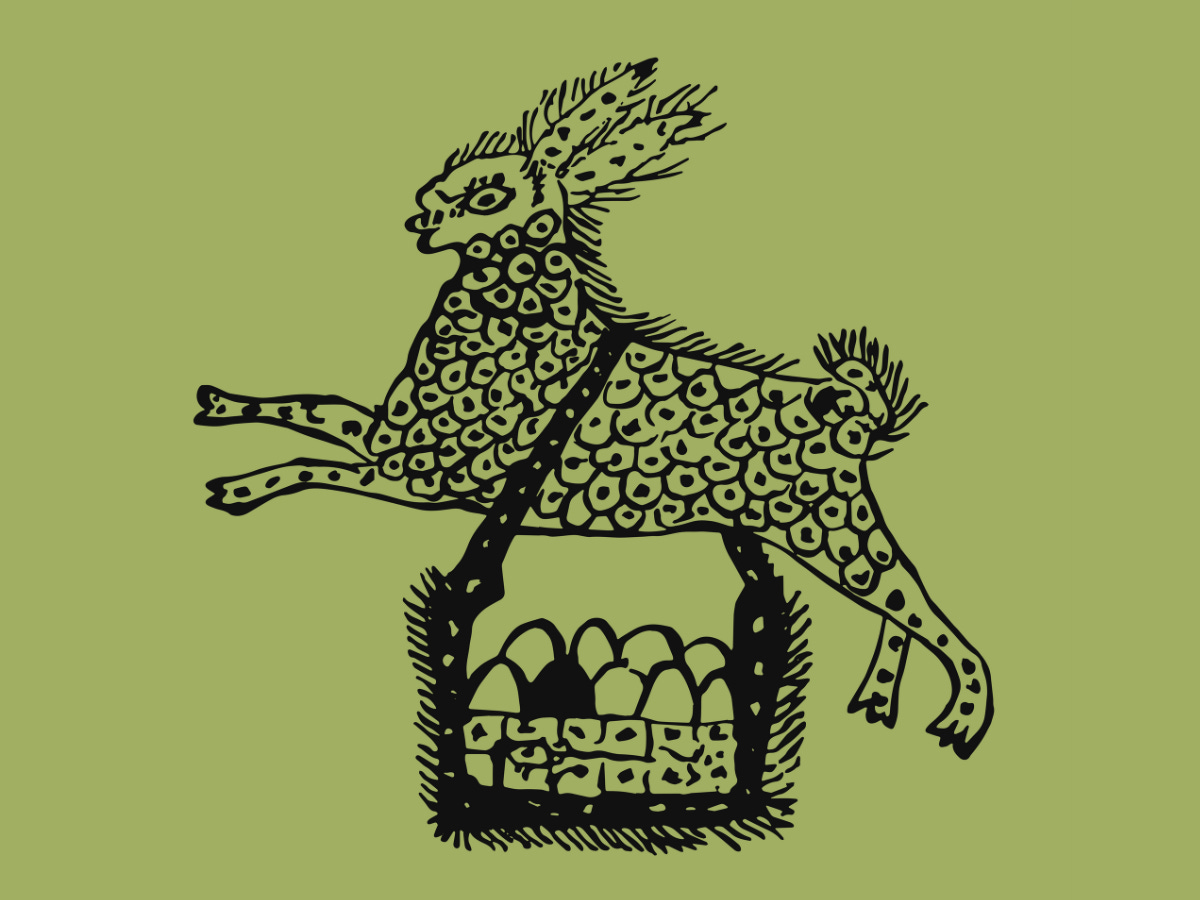
Easter bunny illustration from the late 1700’s by Revolutionary War veteran Johannes Bolich, the oldest known American folk art rendition of the figure
For Medieval agrarian christians and early American settlers alike, Eastertide marked an upswell of both rabbits and eggs, arriving in a sense side by side. They would have been the first abundant sources of protein available to many, and probably conjured up that exuberant feeling unique to spring, the season of potential. Contemporary Easter egg hunts for candy-filled plastic ‘eggs’ were originally egg-eating contests, a clever way to load children up with protein and nutrients at the start of the working year, in which they were participant. Even the bright colors of the Oster-Hase eggs are in direct response to the emerging floral colors of the environment, colors which, if used for egg-dyeing, may have come from the rich pigments of those spring petals.
In the ancient & medieval world, it was commonly thought rabbits were hermaphroditic and therefore gave birth to litters without engaging in sex, drawing sympathy to Mary’s immaculate conception. Though perhaps a sexually repressed medieval bystander would have mistaken the act as play or combat, rabbits have sex often, quickly and vigorously. Unlike most other mammals, rabbits ovulate immediately after mating, leading to a near-100% conception rate. Virginal symbolism falls away like a shell to reveal authentic, Earthy, sexual fertility—much truer to the vernal season. Besides, rabbits are well-known for eating their young, a trait not celebrated in good christian women.
Though today’s bland pastel Easter decor may suggest Spring is sweet and mild, it is in truth a provocative time of anticipation, eroticism and violence. A fresh swell of incarnate beings all push their way into the world, hungry. Eyes, wings and flowers flutter open. There are blossoms, but no fruit, for mother black bear. Chipmunk’s pulse revs from 4 beats per minute to 350 as she wakes from hibernation. The hatching chick uses all its strength to destroy the boundaries of its existence. In that moment, the old creation myths are sung again: the world-egg cracks open, revealing the contained universe.
The beginning of Spring technically occurs when enough ambient heat has generated in a biome to trigger plant growth. This moment has been arriving earlier and earlier in the year for some time, for reasons we are all aware of. The average Spring day is several degrees warmer than it was decades ago. Though uncannily pleasant, a hot Spring day foretells a brutal, unrelenting summer, and can put stress on infant flora and fauna. At this critical juncture, the Land’s fertility & receptivity determine the food security of an ecology for the rest of the year, inevitably provoking anxiety on a communal & individual level. This has been the case since our hunter-gatherer ancestors yearned for new animals to emerge from forests and dens at the start of the living year. In the grocery-shopping cultures of capitalist empire, many will be oblivious to this kind of fear until the strain of climate change begins claiming whole species integral to our food supply.
Nonetheless, through the stress of teething soil, Spring is resplendent. Our Lady dons a new gown of chlorophyll, each somehow more glorious than the last. The once-sleeping ecologies burst out from Earth’s interior to meet with themselves: we all leave our winter nests and present ourselves to our communities anew. The theater of birth, sex, violence and predation returns in full force. We feel the urge to cleanse, like a bird who grooms for mates; to move and explore like a cub; to open our mouths to the world like a hatchling.
The way many live today, insulated and isolated from green places, abstracts these experiences and renders them mutable to commoditization. It is our responsibility to resist this, and instead re-immerse ourselves in the beautiful and unsettling sensory realities of our environments as they shift, chameleon-like, to the tilted dance of Our Mother ‘round the Sun. This is what we are here to witness.
Great Stir of foremothering Soil
Bears tender, ravenous faces.
From silent egg comes crying animal.
Some birds return where others have stayed,
Together trilling the Great Song.
Petals weep as soon as they unfurl.
Snowmelt wets moss mounds on high,
Spun like lambswool into rivers.
Sun, pollen-yellow, rises to ignite
The clinging dew.
Very much enlivened, especially reading the last three paragraphs. Oh I so look forward to receiving it aloud next full moon.